Images of ‘the end of the world’ have been depicted in various forms throughout history.
Concepts of ‘The End’ have been explored in the Bible, various religions, and other historical texts. There are diverse motifs how people in the past thought about ‘The End’.
In 2023, the idea of the ‘end of the world’ feels increasingly familiar.
Stagnant economic growth and low interest rates have deprived us of the opportunity to imagine a prosperous future. Middle-class workers are forced to invest what little leisure time they have after work in improving their skills or in other work to make up for the lack of rising wages.
The unrestricted exploitation of resources continues to destroy the global environment. Global warming and climate change have reached levels that threaten our survival.
Expectations for democracy, which is supposed to control the future of humanity, are diminishing. Violent wars and terrorist acts, such as those between Russia and Ukraine, Israel and Palestine, underline the impotence of dialogue.
How should we face these times?
Certain science fiction novels may offer hints on how to approach these times.
These novels, borne from a blend of imagination and the scientific knowledge of their time, depict the ‘end of the world’ in diverse ways.
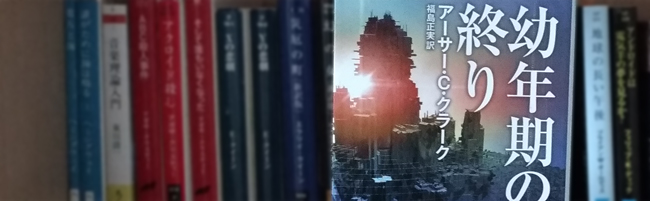
This discussion focuses on ‘Childhood’s End’, examining our relationship with technology through the lens of Clarke’s novel.
‘Childhood’s End’ depicts the future reach of humanity.
Arthur C. Clarke’s ‘Childhood’s End’ is a seminal novel in British science fiction. It was published in 1953. It remains Clarke’s best-known work and is still widely read as a masterpiece in the history of science fiction.
The novel unfolds as follows.
One day in the late 20th century, a huge cluster of spaceships covers the skies of Earth. It was the first contact between humanity and the Overlords, aliens with intelligence and technology far more advanced than that of Earth. Fifty years later, under the rule of the Overlords, mankind enters a time of conflict-free, peaceful, art-loving prosperity.
The Overlords, who rule and oversee humanity, have a certain purpose that they cannot reveal to humanity. With the cooperation of the Overlords, mankind solves problems related to war, resources and the environment one after another … On the other hand, however, humanity harbours a distrust of their hidden purpose.
The novel questions the future of Earth as human intelligence evolves to understand its true purpose. What will humanity think and do?
This story explores what humankind is.
What will humanity say when it reaches the final stage of evolution?
Encounters with the unknown, the management of the Earth by a higher intelligence, human progress and insecurity — these themes are now commonplace.
However, the vision of the future depicted in ‘Childhood’s End’ is entirely fresh and inspiring.
The story reaches its climax through Jan’s narrative. He, as a human, grapples with the impending end of our existence.
Humanity had reached the pivotal point in history of Earth and the sapience. But what awaited them was the loneliness bequeathed by a new race. It was a tragic end of sorts. When confronted with a great power and destiny that transcended individual strength, man was too helpless. Nevertheless, ‘mankind’ is proud of itself to the end.
We will not give up telling our history until the very end. Is that why we are human beings ……?
This invites a comparison with ‘The Door into Summer’. There is a contrast of futuristic vision between these novels. ‘The Door into Summer’ is an American science fiction novel published at the same time. But the technology and the future in it give a sense of hope.
What I find particularly interesting is that the arrival of humanity at the ‘Childhood’s End’ is not ‘individual’ but ‘total’. This is where humanity, as one component in a larger system, sublimates the spirituality and artistry that humans have always valued in order to become a more rational being.
From the standpoint of observing human evolution from the outside, this is seen as a fear of ‘losing our humanity’. But from an evolutionary standpoint, it is a natural phenomenon and does not feel different.
This fear is more than humanity holds for the overlords.
And this is a phenomenon that is happening now, as we live in the 2020s.
Discourses on AI and humans
The development of AI represents a significant technological milestone. Consider, for example, the defeat of ‘Ke Jie’, a 9-dan Go master, by AI ‘Alpha Go’ in May 2017.
As the evolution of artificial intelligence continues to outpace some of the human brainpower, a variety of opinions have been expressed about the future of humanity.
One view is that it will still be quite some time before AI catches up with humans. It is argued that humans have superior (different) capabilities than AI, especially in areas such as ideation and invention. This view posits that certain intellectual tasks, like free thinking and invention, remain beyond the capabilities of machines.
On the other hand, some are of the opinion that there is no significant difference between humans and AI in terms of ideas and inventions. For instance, much like a machine cannot articulate the reasoning behind its actions, a human may struggle to rationalize their own behaviors.
It is said that ideas and inventions can only be created by humans, but they do not come down from the heavens, but are created by reference to knowledge and experience, such as past examples and failures. In this respect, it is no different from the AI’s way of thinking.
But if they are no different from humans, will there be no difference between humans and machines?
Is AI the enemy?
‘Childhood’s End’ seems to be modelled on the world situation during the Cold War. So the contrast between human progress and old values that was depicted can be seen as that of communism and democracy.
However, this contrast seems to be repeating itself anew with the digitalisation of society, including AI.
It is not capitalism and its opponents that are in contention this time. It is those who have adapted more quickly to capitalism and those who have not.
The most suggestive future vision that ‘Childhood’s End’ teaches us is that overlords are also just parts of a system. They learn from humans and sometimes even respect their drive, but they do not become friends.
Humans and Overlords spend decades conversing, learning to know each other, and filling in knowledge where their own species lacks.
But the relationship only goes so far, parallel and on each other’s path to the end.
This episode may pose a significant suggestion. As what is a difference of evolving between humanity and technologies?
Humanity and AI, humanity and smartphones, humanity and the internet, humanity adapting to accelerating technological change and humanity not adapting ……etc.
While the debate about friend or foe is lively, there can also be a kind of obvious conclusion that what awaits us in the end is that machines are machines and nothing more.
A new variant system of questions about the future of human beings
If this is the case, then we may be returning to the primordial question of how humans will live in the future, not “the future of AI and humanity”, but “the future of humanity adapted to an environment with AI and humanity today”, the relationship between people and humanity.
Modern philosophy has long grappled with these themes throughout its history. A discussion of the relationship between humanity and technology is some of that.
The technological progress of AI seems to have triggered new questions about the ‘human crisis’, which has been repeated many times by Marx, Heidegger, Foucault and others.
Much time will still be needed before these debates can be refined.